
Safety
Kitesurfing and wing foiling share the water with many other users: swimmers, other riders, boats. These right-of-way and common-sense rules apply to everyone, on every spot on the island.
Right-of-way rules
Right-of-way rules for kite/wing sports are based on sailing's rules of navigation. Whoever has priority, it remains your responsibility to avoid a collision at all costs, by applying COLREGs (the International Regulations for Preventing Collisions at Sea): the golden rule always comes first — avoiding a collision matters more than asserting your priority.
01Priority to the leeward rider
The rider positioned downwind (leeward) has priority. The one upwind must move out of the way and raise their kite, while the priority rider keeps theirs low.
02Priority to starboard
On different tacks, the rider with the wind coming over their starboard (right) side has priority; the other must change course.
03Priority to launching and landing
A rider launching or landing has priority. No one else should fly their kite in that area.
04Priority to the departing rider
The rider leaving the beach to head out has priority over one coming in: the latter must give way.
05Priority at the zenith
A rider whose kite is straight up (zenith, 12 o'clock) has priority over the others.
06Safety distance
Keep at least 50 metres from other riders and obstacles before a jump, a trick, or a change of direction.
07Overtaking
The rider being overtaken has priority: the one overtaking must keep a safe distance and adjust their speed — kite high if passing upwind, kite low if passing downwind.
08Priority to the rider surfing a wave
A rider surfing a wave has priority over other users around them.
09360° awareness
Keep a constant eye on other water users; spot riders as soon as they're within about a hundred metres, and always give way to whoever is least able to manoeuvre.
10Priority to non-motorised users
Swimmers, bathers, surfers and paddlers always have priority over kiters and wingers.
11Professional traffic
Professional maritime traffic has priority over all recreational users.
Based on the FFVL's (Fédération Française de Vol Libre) navigation rules.
Local rules: swimmers & summer
Île de Ré is very busy in summer, with many swimmers on the beaches. Some towns regulate or ban the activity at certain times or in certain areas: see the full detail on the Spots page, in the "Rules & restrictions by village" section.
Common sense on the water
Assisted launch
Launching is the trickiest moment: always have someone help you, and agree on the procedure before launching the kite.
- 1
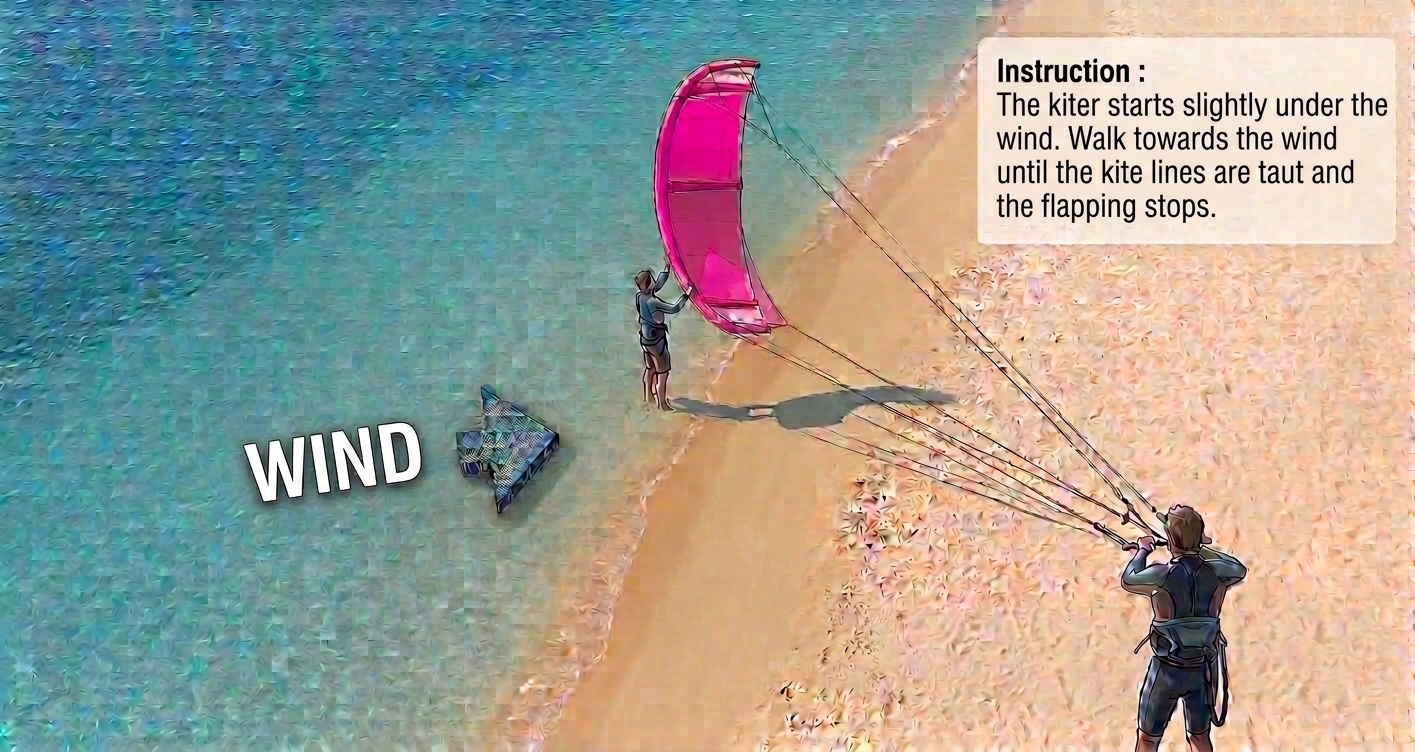
Position yourself slightly downwind
The assistant holds the kite flat on the ground, leading edge facing the wind. The rider stands slightly downwind, bar in hand and leash attached, then walks into the wind until the lines are taut and the kite stops flapping.
- 2
Check the lines and hook into your harness
Make sure all lines are clear and untangled, then hook the bar to your harness.
- 3
The assistant holds the kite straight up, ready to launch
The assistant holds the kite by the leading edge, straight up facing the wind, ready to release it as soon as the rider is ready.
- 4
Launch gently up to the zenith
The assistant lets go of the kite: it's the rider, on the bar, who gently steers it up to the zenith (12 o'clock).
- 5
Check the kite before moving away
Once the kite is steady at the zenith, check that it turns properly both ways before moving away. Signal thanks to your assistant.
Advice from experience
Mishaps lived by association members, shared so others don't repeat them.
Always carry a line cutter
An association member once got stuck in a buoy with the lines tangled around their legs. A line cutter within reach at all times can make all the difference if the lines get tangled or caught on an obstacle.
Practise releasing your kite
The bar can get caught in the lines and make the kite uncontrollable when releasing. Practise releasing regularly, including in strong wind, so the motion becomes a reflex the day you actually need it.
Always check your anchor point
A hook that's poorly buried or fitted upside down can let go without warning — the part that connects to the bar should face up, not down. Seen at La Loge this summer — a kite flew off towards the houses. Check the depth and orientation of your anchor before moving away from your gear.